On this date
Mosienko scores fastest hat trick ever

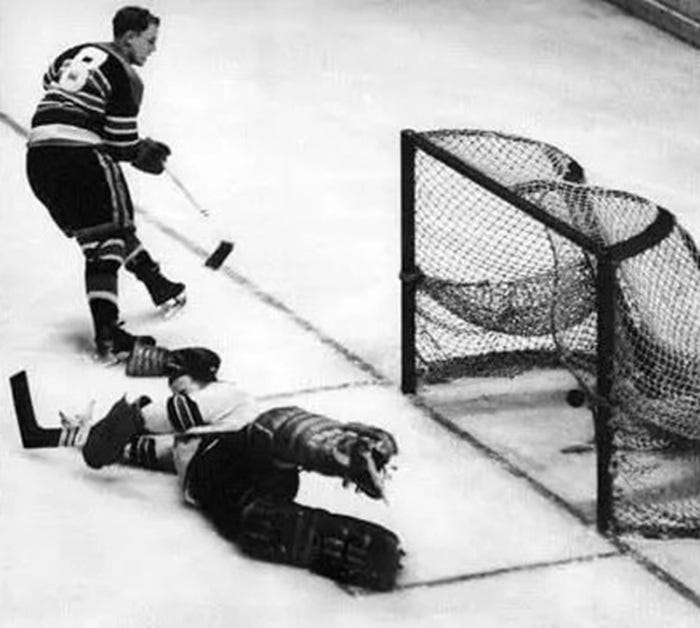
During the quarter-century run of the NHL’s “Original Six” era four of the teams made the playoffs each season.
Sunday, March 23, 1952, was the final day of the 1951-52 regular season and the Chicago Black Hawks and New York Rangers knew they were the odd teams out as they prepared to play out the season.
With nothing at stake as far as playoff positioning or getting one final tuneup before the start of postseason play, that day’s game could have been forgettable.
Only 3,254 of Madison Square Garden’s 15,925 tickets were sold for the game that would feature Bill Mosienko accomplishing one of the top feats in league history as he scored a hat trick in 21 seconds in third period.
Chicago scored first but New York led 3-2 after the first period, had a 5-2 advantage after two and increased the margin to 6-2 at 3:37 of the third.
That’s when Mosienko stepped up.
Mosienko, who was serving temporarily as captain, scored a goal at the 6:09 mark. He took a feed from Gus Bodnar, swung around Buller, cut in front of Anderson and slid the puck under the goalie’s gloved hand at 6:09.
The next goal came 11 seconds later at 6:20 and was a carbon copy of the first. From the faceoff, Bodnar found Mosienko at the Rangers’ blue line, where the winger dodged Buller and beat Anderson, again under the glove, at 6:20.
The third goal came 10 seconds later as Bodnar knocked the puck to George Gee, who fed a flying Mosienko crossing into the middle of the Rangers’ zone.
Anderson went low in anticipation. An alert Mosienko instead flipped the puck over the glove at 6:30.
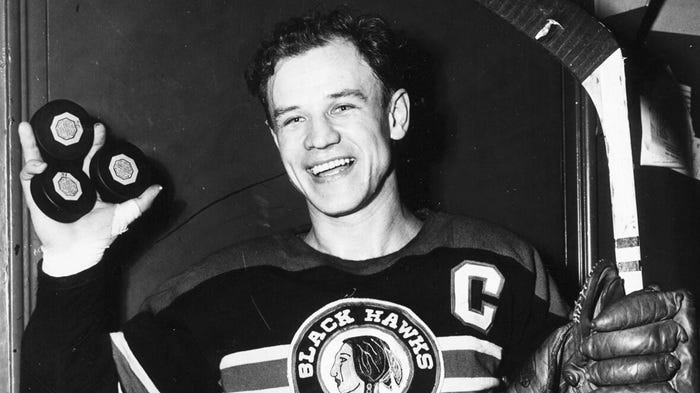
The previous hat trick record was held by Carl Liscombe of the Detroit Red Wings, who did it in 1 minute and 52 seconds against Chicago in 1938.
That cut the Rangers lead to 6-5.
Sid Finney scored for Chicago at 13:50 and again at 19:22 and the Black Hawks closed out the season with a remarkable come-from-behind 7-6 win.
Ty Dilello is author of Mosienko: The Man Who Caught Lightning in a Bottle.
“It’s just an incredible record from an incredible guy. I think it’s going to stand forever,” he told the Winnipeg Free Press.
“It’s remarkable. It’s so hard for a player to score even two goals in that time. Dilello is an accredited writer with the International Ice Hockey Federation and member of the Society for International Hockey Research.
The Rangers brought up goalie Lorne Anderson from their farm team, and defenseman Hy Buller was skating on a cracked ankle. But none of that diminishes Mosienko’s accomplishment, Dilello said.
“A lot of things had to go right,” he said. “Three goals in 21 seconds is such a rare oddity that I don’t really think it matters. It would be hard enough to do against a minor league team. It’s just an amazing feat.
“Bad time to go to the bathroom,” said Dilello, wondering how many in attendance saw what happened in the ticks it takes a heart to beat 30 times.
Mosienko very nearly added a fourth goal about 45 seconds later.
“I was alone again. I faked Anderson out of position, had an open goal to hit and shot wide,” he is quoted saying in the book, The Game I’ll Never Forget: 100 Hockey Stars’ Stories, by Chris McDonnell.
He told reporters after the game he simply got lucky and “caught lightning in a beer bottle.”
That modesty was a character trait of a man also remembered as one of the nicest individuals around, Dilello said.
“There might have been some better hockey players from Manitoba, but as an ambassador of the game, I don’t think there was a better one than Bill Mosienko,” he said.
“He was literally friends with everybody. Just a total gem.”
He retired after the 1954-55 season as a five-time all-star and played his entire career with Chicago. Mosienko’s final NHL goal came, appropriately, against the Rangers.
He’s a member of the Hockey Hall of Fame, Manitoba Sports Hall of Fame and Manitoba Hockey Hall of Fame.
In 1991, the City of Winnipeg renamed Keewatin Arena to Bill Mosienko Arena to honor him. He died three years later from brain cancer at age 72.
Box score
Here’s the box score from the game where Mosienko recorded his hat trick.
Chicago 2 0 5 – 7
New York 3 2 1 – 6
Scoring Summary
First period
Chicago: Gus Bodnar (Bill Gadsby, Bill Mosienko) 0:44
New York: Frank Eddolls (unassisted) 4:50
New York: Don Raleigh (Gaye Stewart, Allan Stanley) 17:12
New York: Ed Slowinski (Don Raleigh, Gaye Stewart) 18:35
Chicago: Pete Horeck (Fred Huccu, Sid Finney) 18:47
Second period
New York: Gaye Stewart (Ed Slowinski) 13:19
New York: Herb Dickenson (Wally Hergesheimer, Paul Ronty) 15:55
Third period
New York: Ed Slowinski (Don Raleigh) 3:37
Chicago: Bill Mosienko (Gus Bodnar) 6:09
Chicago: Bill Mosienko (Gus Bodnar) 6:20
Chicago: Bill Mosienko (Gus Bodnar, George Gee) 6:30
Chicago: Sid Finney (Fred Hucul, Lee Fogolin) 13:50
Chicago: Sid Finney (Bill Gadsby) 19:22
On that date
No. 1 TV show: Arthur Godfrey’s Talent Scouts, CBS
No. 1 Movie: The Greatest Show on Earth
No. 1 song: Wheel of Fortune, Kay Starr
No. 1 book: The Caine Mutiny, Herman Wouk
Governor of Minnesota: C. Elmer Anderson
U.S. President: Harry S. Truman
Significant news story: A March blizzard, the worst of the winter, swept across northwestern Kansas, Nebraska and Iowa today, disrupting telephone and telegraph communications and blocking highway travel.
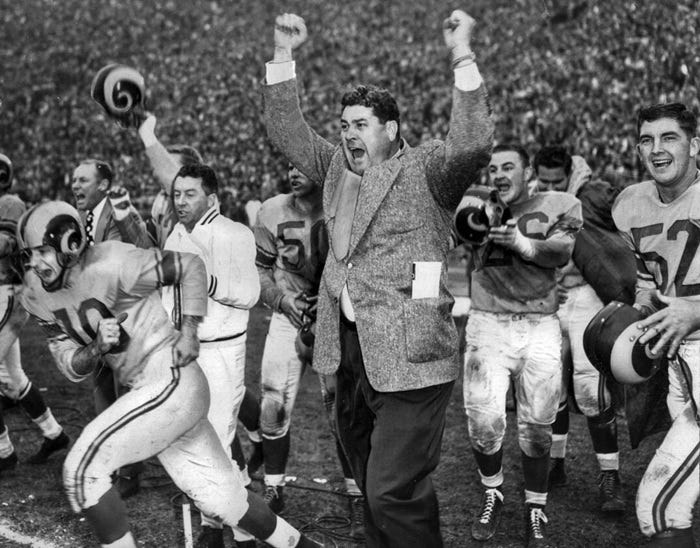
We are the champions
Here are the reigning champions in each sport on March 23, 1952.
NFL: Los Angeles Rams
World Series: New York Yankees
NBA: The Rochester Royals won the NBA title in 1951. The franchise was the Rochester Royals from 1948-1957, Cincinnati Royals from 1957-1972, Kansas City-Omaha Kings from 1972-1975, Kansas City Kings from 1975-1985 and have been the Sacramento Kings since 1985.
The Minneapolis Lakers won the 1952 title on April 25 as they won the championship series over the New York Knicks 4-1.NHL: The Toronto Maple Leafs won the Stanley Cup in 1951.
Detroit won the title in 1952 with a 4-0 sweep of Montreal with the series ending on Apri; 15.College football: Tennessee
College basketball: Kentucky won the 1951 NCAA title at Williams Arena in Minneapolis. Kansas would win the 1952 championship game on March 26 in Seattle, beating St. John’s 80-63.
Masters: Ben Hogan
Daytona 500: The first Daytona 500 wasn’t held until 1959, but Marshall Teague won the major NASCAR Grand National race on the Daytona Beach Road Course that February.
Indy 500: Lee Wallard
SOURCES: Hockey Hall of Fame, cbc.ca, hockeyrefenece.com, Los Angeles Times, Winnipeg Free Press.